
Security management services provide a strategic, proactive approach to protecting your business from digital threats. Unlike traditional, reactive IT support that fixes problems after they occur, these services focus on continuously monitoring, managing, and improving your security posture to prevent incidents from happening in the first place. This shifts cybersecurity from an unpredictable expense to a managed operational cost, reducing business risk and ensuring operational stability.
For business leaders, this means entrusting your digital safety to a dedicated team of specialists who work around the clock. Their goal is to safeguard your sensitive data, maintain regulatory compliance, and protect your company’s reputation, allowing you to focus on core operations with confidence.
What Do Security Management Services Include?
Think of security management as a comprehensive security program for your business, delivered by an external partner. Instead of just installing an alarm system and hoping for the best, you are hiring a professional firm to actively guard your digital assets 24/7. They don’t just set up defenses; they patrol your network for vulnerabilities, monitor for threats, and are ready to respond the moment an incident occurs.
This proactive stance is critical for any organization handling sensitive client data or navigating strict compliance regulations. The objective is to build a resilient environment where security is managed continuously by specialists, not as an afterthought. You can learn more about how this compares to traditional IT support in our guide to managed IT services.
A Strategic Business Investment
Adopting security management services transforms how you budget for technology. It ends the cycle of unpredictable, emergency-based spending and converts security into a predictable, fixed monthly operational cost. This eliminates surprise invoices for incident response or emergency hardware, allowing for smarter financial planning.
The market reflects this shift. In the Caribbean region, security services became the cybersecurity industry's largest segment in 2023, generating US$88 billion in revenue. Projections show this figure growing to US$114.7 billion by 2028, underscoring how vital these services have become for businesses of all sizes.
This shift provides more than technical protection; it delivers business peace of mind. By entrusting security to a dedicated partner, leaders can focus on core operations, confident that a team of experts is safeguarding their digital assets, reputation, and client trust around the clock.
To clarify the value, let’s compare a dedicated security partner to relying solely on an in-house IT team, which often must balance security with numerous other responsibilities.
In-House IT vs. Managed Security Services
| Aspect | In-House IT Team | Managed Security Services |
|---|---|---|
| Focus | Broad; manages all IT functions (helpdesk, infrastructure, etc.) | Specialized; dedicated solely to cybersecurity. |
| Cost Model | Primarily capital expense (salaries, benefits, tools) and unpredictable operational costs. | Predictable monthly operational expense (subscription-based). |
| Expertise | General IT knowledge; may lack deep, specialized security skills. | Team of certified security experts with diverse, specialized knowledge. |
| Availability | Typically standard business hours; 24/7 coverage is expensive and difficult to staff. | Guaranteed 24/7/365 monitoring and incident response. |
| Tools & Technology | Limited by budget; may struggle to afford enterprise-grade security tools. | Access to advanced, enterprise-grade security platforms and threat intelligence. |
| Approach | Often reactive; responds to issues as they arise due to competing priorities. | Proactive; focuses on continuous monitoring, threat hunting, and prevention. |
While an in-house team is invaluable for day-to-day IT support, a managed security services provider brings a level of specialized expertise and round-the-clock vigilance that is difficult and costly to replicate internally. They work with your existing IT team, not against them, to create a much stronger, layered defense.
The Core Components Of A Strong Security Program
An effective security program is not a single piece of software but a system of interconnected functions working in concert. Each component addresses a specific type of risk, creating a layered defense that is far more difficult to breach than any standalone tool. Understanding these pillars is key to seeing what security management services deliver for your business.
This model shows how a complete security program should function—with monitoring, response, and strategy all revolving around the core goal of protection.
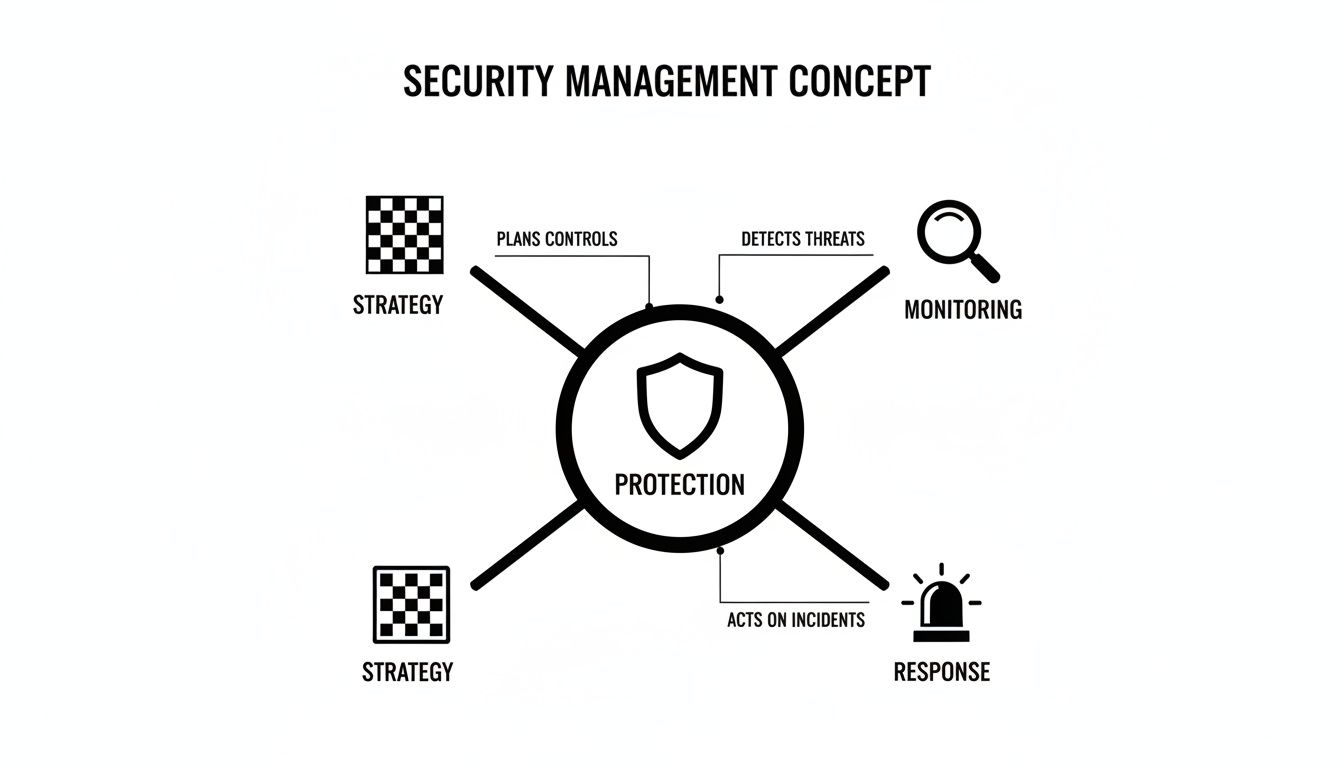
True security is a continuous cycle of strategic planning, constant vigilance, and decisive action when an incident occurs.
Threat Monitoring and Response
This is the 24/7 surveillance team for your digital environment. Using powerful tools like Security Information and Event Management (SIEM) systems, experts monitor network traffic, server logs, and user activity for any signs of suspicious behavior. The moment a credible threat is detected, the response team acts immediately to contain and neutralize it.
The demand for this constant oversight is growing rapidly. Managed security services are projected to grow at a 12.0% compound annual rate in Latin America and the Caribbean. Managed Detection and Response (MDR) is a significant part of that trend, demonstrating how much businesses now rely on active monitoring to protect their data.
Vulnerability and Patch Management
These two functions work together to secure your digital infrastructure. Vulnerability management acts as a regular health check for your systems. It involves systematically scanning for weaknesses, such as outdated software or misconfigurations, that an attacker could exploit.
Patch management is the process of remediating those weaknesses. It is the digital equivalent of ensuring every door and window in your building is locked and reinforced. Consistent patching is one of the most effective ways to prevent cyberattacks, as many breaches exploit known vulnerabilities for which a fix is already available.
A well-managed patching process eliminates the low-hanging fruit that attackers often target. It transforms your systems from a collection of potential entry points into a hardened, resilient environment, significantly reducing your attack surface.
Identity and Access Management
Identity and Access Management (IAM) serves as your company’s digital bouncer. Its function is to ensure only authorized individuals can access specific data, applications, and systems.
IAM enforces policies like multi-factor authentication and the principle of least privilege, which grants employees access only to the information they absolutely need to perform their jobs. This simple concept dramatically reduces the risk of both external attacks and internal data misuse. If you're curious about protecting individual devices, you might be interested in our article on what endpoint detection and response is.
Incident Response and Compliance
No security system is infallible. An Incident Response (IR) plan is an emergency playbook that outlines the exact steps to take if a breach occurs. It details how to contain the damage, eradicate the threat, restore systems, and communicate with clients and stakeholders. A well-defined plan minimizes operational downtime and protects your reputation.
Finally, Compliance Management ensures your business adheres to industry-specific regulations like HIPAA or PIPEDA. This involves translating complex legal requirements into practical security controls and maintaining the necessary documentation for audits. For a deeper look at building an effective program, this practical guide to security risk assessment is an excellent resource.
Why Proactive Security Is A Business Imperative
While the technical details are important, the true value of a security program lies in its business impact. Shifting to proactive security management services is more than a technology upgrade; it is an investment that directly addresses your greatest operational, financial, and reputational risks.

At its core, the goal is to reduce business risk. By identifying and stopping threats before they cause damage, you shield your organization from significant financial losses, operational disruption, and the reputational harm that can linger long after a breach is resolved.
Gain Predictable Cost Control
Relying on reactive IT support can lead to budget instability. A single security incident can trigger a wave of unplanned expenses, including emergency response fees, data recovery costs, and urgent system repairs. This makes financial planning difficult.
Security management services change this dynamic by converting unpredictable expenses into a fixed, manageable operational cost. For a predictable monthly fee, you gain access to a team of seasoned experts and enterprise-grade technology. This eliminates budgetary surprises and allows you to allocate resources with confidence, turning security into a planned investment rather than a crisis response.
Enhance Operational Resilience
Downtime is a direct threat to your bottom line. A successful cyberattack can halt your operations for days or even weeks, preventing your team from serving clients, billing hours, or meeting deadlines.
Proactive security is designed to prevent the incidents that cause downtime. With continuous system monitoring and a plan to respond within minutes, potential disruptions are contained and resolved quickly. This ensures your business continues to operate, preserving client trust and maintaining momentum.
A proactive security posture is the foundation of modern business resilience. It ensures that your technology serves as a reliable engine for growth, rather than a potential source of catastrophic failure, allowing you to focus on your core mission with confidence.
Navigate Compliance With Confidence
For businesses in regulated industries like law, finance, or healthcare, compliance is a constant pressure. The regulations are complex, the stakes are high, and the penalties for non-compliance are severe.
A dedicated security partner is invaluable in this context. They have deep expertise in these regulatory frameworks and provide key benefits:
- Audit Readiness: Maintaining the necessary documentation and controls to pass audits successfully.
- Risk Mitigation: Implementing security measures that map directly to specific compliance requirements.
- Expert Guidance: Offering clear, straightforward advice on complex regulations to ensure your practices remain compliant.
This partnership helps you meet your obligations without guesswork, protecting your business from fines and legal challenges. To stay ahead, a modern security program must incorporate the latest data breach prevention tools and strategies. The greatest benefit is access to specialized expertise that is difficult and expensive to build in-house.
How To Choose The Right Security Management Partner
Choosing a security partner is about entering a long-term relationship based on trust, shared goals, and expertise. It is more like adding a specialist to your team than simply purchasing a product. The right choice can strengthen your defenses, while the wrong one can lead to mismatched expectations and wasted investment. The goal is to find a provider who acts as a natural extension of your team, bringing proactive thinking and deep knowledge to the table.
Evaluate Industry and Compliance Expertise
Begin by looking for a provider with proven experience in your specific industry. A partner who understands the unique regulatory pressures and operational challenges of a law firm, for example, will be more effective than a generalist. They should be able to speak your language from day one.
Ask for their track record with compliance frameworks relevant to your business, such as PIPEDA or HIPAA. They should clearly articulate how their services help you meet your obligations and provide the necessary documentation for audits. A true partner helps you manage both security and compliance risk.
Assess Their Technology and Infrastructure
A provider's technology stack is the engine that drives their services. Inquire about the platforms they use for threat detection, vulnerability scanning, and incident response. It is critical to ensure their tools integrate smoothly with your existing systems.
Equally important is the strength of their own infrastructure. The Caribbean data centre market is projected to reach USD 120.4 million by 2027, highlighting the growing importance of secure and reliable facilities for delivering managed services.
A provider's real value isn't measured by how many alerts they generate, but by their ability to deliver clear, actionable intelligence. Look for a partner who translates complex security data into plain English, helping you understand your risk and make smarter business decisions.
Scrutinize Agreements and Communication
The details of your agreement are crucial. A detailed Service Level Agreement (SLA) is non-negotiable. It should clearly define key performance metrics, including guaranteed response times for different types of security incidents. Vague promises are a red flag; you need firm, measurable commitments.
Communication is just as vital. Inquire about their reporting process and ask for sample reports. The best partners provide transparent, easy-to-understand reports that connect security activity to business outcomes. You can see what a comprehensive partnership looks like by reviewing our overview of professional cybersecurity services. Consistent, clear communication is the foundation of a successful partnership.
Provider Evaluation Checklist
Use this checklist to compare potential providers and ensure you cover all critical bases. This structured approach helps you move beyond the sales pitch and focus on what truly matters for your organization’s security.
| Evaluation Criteria | Provider A | Provider B | Notes |
|---|---|---|---|
| Industry Experience | Do they have case studies in our sector? | ||
| Compliance Expertise (PIPEDA, etc.) | Can they show proof of audit support? | ||
| Technology Stack & Integration | Will their tools work with our systems? | ||
| Defined Service Level Agreement (SLA) | Are response times clearly stated? | ||
| Communication & Reporting | Ask for sample reports. | ||
| Incident Response Plan & Process | How do they handle a major breach? | ||
| Team Certifications & Expertise | Who is actually managing our security? | ||
| Scalability & Future-Proofing | Can they support our growth? | ||
| Client References | Speak to at least two current clients. | ||
| Pricing Transparency | Are there any hidden fees? |
This checklist should provide a clear picture of which provider best aligns with your needs. The goal is to find a partner who meets your technical requirements and fits your company culture.
Your Roadmap to Implementing Managed Security
Transitioning to a managed security model is a strategic journey, not an overnight switch. Understanding the steps involved makes the process manageable and ensures a smooth transition. The objective is to build a stronger security foundation without disrupting your daily business operations.

The path forward is methodical, with each action planned to align with your business goals and risk profile. It is a collaborative effort designed to deliver measurable improvements to your security posture.
Initial Assessment And Risk Analysis
The process begins with a thorough assessment of your current environment. Your security partner will conduct a detailed analysis of your existing technology, processes, and potential vulnerabilities. This creates a baseline—a clear snapshot of your current security posture. This phase is also about understanding your business, identifying critical data assets, evaluating risk exposure, and clarifying compliance obligations.
Customized Security Roadmap
Once the assessment is complete, the next step is to create a customized roadmap. This strategic blueprint connects your security initiatives directly to your business objectives. It is a tailored plan that prioritizes actions based on risk and impact, not a generic template.
This roadmap will outline:
- Key priorities for the first 90 days, six months, and the first year.
- The specific technologies and processes to be implemented.
- Clear milestones and timelines for each phase.
Phased Implementation And Onboarding
With the roadmap approved, implementation begins in carefully managed phases to minimize disruption. New tools are deployed, security policies are refined, and your team is brought into the loop through structured onboarding and training. Clear communication is vital during this stage to ensure a smooth transition and help everyone adopt new, more secure practices.
The ultimate goal of implementation is not just to install new software, but to weave stronger security practices into the fabric of your organization. It’s a process of thoughtful integration that enhances protection while supporting productivity.
Ongoing Management And Reporting
After implementation, the process shifts to the continuous cycle of ongoing management. This is where the true value of security management services becomes apparent. Your partner begins 24/7 monitoring, threat hunting, and proactive maintenance. You will receive regular, clear reports that translate complex security data into meaningful business insights, ensuring you are always informed about your security status.
Frequently Asked Questions
Business leaders often have practical, bottom-line questions when considering a security management partner. This section provides direct answers about the real-world costs, scope, and implications of professional security services.
How Much Do Security Management Services Cost?
There is no single price for security management services, as costs are tailored to each business. Pricing typically depends on the number of users and devices, the complexity of your IT environment, and any specific compliance requirements you must meet. Most providers use a subscription model, which converts security into a predictable monthly operational expense. This approach avoids the large, unplanned costs associated with responding to a security breach. An initial assessment allows a provider to develop an accurate quote for your business.
Is Our Business Too Small for This Level of Security?
This is a common but dangerous misconception. Smaller businesses are often prime targets for cybercriminals because they are perceived as having fewer security resources. Attackers view them as easy entry points to access valuable data. Professional security management services are scalable, giving small and mid-sized businesses access to enterprise-grade protection at a fraction of the cost of building an in-house team. This levels the playing field, ensuring your operations and client data are secure, regardless of your company’s size.
A security breach can be just as devastating for a small business as it is for a large enterprise—sometimes even more so. Proactive protection isn't a luxury; it's a foundational investment in your company's growth and resilience.
What Is the Difference Between Managed IT and Managed Security?
While they sound similar, managed IT and managed security services have distinct functions. Managed IT services focus on keeping your technology running smoothly for daily operations. This includes helpdesk support, network maintenance, and ensuring your systems are efficient and reliable. Security management services are focused solely on protecting your business from digital threats. This specialized field involves 24/7 threat monitoring, vulnerability management, incident response, and compliance. In short, managed IT keeps the lights on, while managed security ensures no one breaks in.
How Long Does the Onboarding Process Typically Take?
The onboarding timeline depends on the complexity of your IT environment and the services being implemented, but it generally takes from a few weeks to a couple of months. A good provider will conduct this process in carefully planned phases to minimize disruption.
The process typically includes:
- Initial Assessment: A deep dive into your current systems.
- Roadmap Development: Creation of a customized implementation plan.
- Phased Deployment: A staged rollout of tools and security controls.
- Team Training: Ensuring your staff is comfortable with new procedures.
Your partner should provide a clear timeline from the start and maintain open communication throughout the process to ensure a smooth transition.
At Tricord I.T Solutions, we provide the clarity and expertise needed to build a resilient and compliant security posture for your business. Our tailored security management services are designed to reduce risk and provide peace of mind, allowing you to focus on your core objectives.
Schedule a complimentary security consultation to assess your current vulnerabilities.