
For a modern law firm, IT support is more than just fixing computers. It is a specialized discipline that integrates technology management, cybersecurity, and compliance services tailored to the unique operational and ethical demands of the legal profession. This strategic approach protects sensitive client data, ensures adherence to professional responsibilities, and maintains the operational uptime essential for meeting deadlines and serving clients effectively.
Think of specialized law firm IT support as the digital equivalent of a secure client vault and confidential meeting rooms. It provides a foundational framework for managing the specific risks inherent in legal practice, transforming technology from a reactive expense into a strategic asset that supports firm growth and protects its reputation.
Why Generic IT Is a Business Risk Modern Law Firms Cannot Afford
In the high-stakes legal field, your IT infrastructure is the bedrock of client confidentiality, ethical compliance, and operational stability. Opting for a generic, one-size-fits-all IT provider may seem like a cost-saving measure, but it introduces significant vulnerabilities that a modern practice cannot afford. Standard IT providers often lack familiarity with the legal software, strict data handling regulations, and professional duties that govern your firm.
This knowledge gap can lead to catastrophic oversights in security and compliance. For a law firm, a data breach is not merely a technical problem; it is a potential ethical violation that can shatter client trust and inflict permanent damage on the firm's reputation. Inadequate IT exposes a firm to cyber threats targeting sensitive case files, non-compliance with privacy laws like the CCPA, and operational disruptions that erode billable hours.
The Shift Toward Specialized Needs
The legal market itself is changing, placing greater demands on technology. In California, for example, the landscape has shifted dramatically. Three-quarters of all law firm receipts now come from organizational clients, a trend driven by the explosion of in-house legal departments, which grew by a staggering 45.3% in California between 2016 and 2023.
For firms in this region, this means a much heavier reliance on a solid IT infrastructure to manage complex corporate data and keep sensitive communications locked down. You can dig into these legal market trends in the State Bar of California's latest report.
Viewing your IT support as a core business function is no longer optional. It is a strategic imperative that directly mitigates risk, enables growth, and secures your firm’s most valuable asset—its reputation.
The Strategic Value of Legal-Focused IT
This is where specialized IT for Law Firms and Attorneys provides a distinct advantage, transforming technology from a cost center into a strategic asset. A partner who understands the legal field does more than fix problems; they deliver proactive solutions designed around your firm's specific challenges. This includes:
- Compliance Assurance: Designing and managing systems that adhere to the legal industry’s strict data privacy and retention standards.
- Enhanced Security: Implementing security protocols tailored to defend against threats that specifically target law firms.
- Operational Efficiency: Optimizing legal-specific software and workflows to improve productivity and client service delivery.
Ultimately, investing in industry-specific expertise is the only way to ensure your technology infrastructure is not a liability, but a secure foundation for your practice’s success.
Core Components of Specialized Law Firm IT Support
Effective IT support for a law firm is an operational strategy, not just a help desk. It is built on several critical pillars that move far beyond the traditional "break-fix" model to focus on proactive measures that protect the firm, enhance efficiency, and support growth.
Understanding these core components is the first step toward building a technology foundation that serves as a strategic asset. This shift in perspective elevates your IT provider from a technician to a partner invested in your firm's success by prioritizing prevention over repair and aligning every technology decision with your business goals.
The wrong approach places the entire firm at risk. Generic, reactive IT sits at the top of the risk hierarchy, directly threatening your most critical assets.
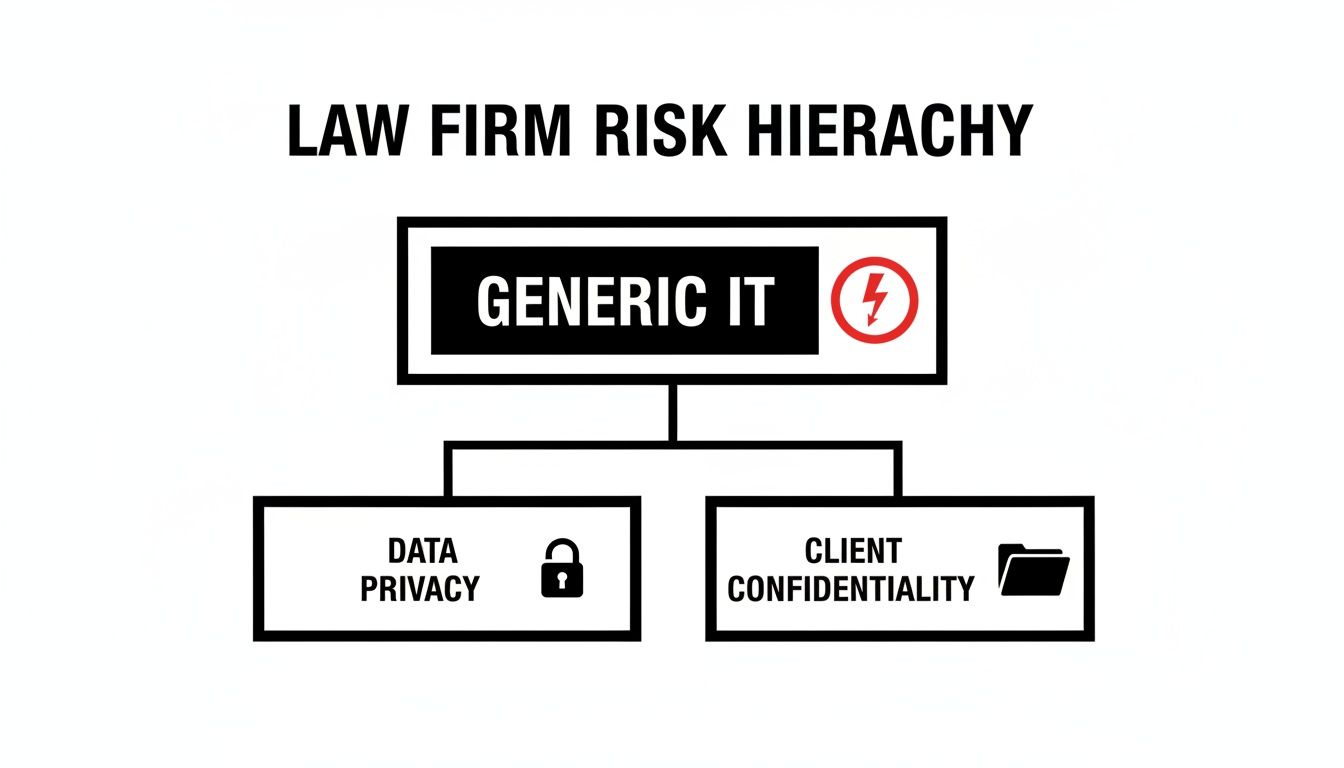
As this illustrates, poor IT management is a primary business risk that cascades downward, placing client confidentiality and data privacy in jeopardy. The following table breaks down the difference between basic support and a strategic partnership.
Comparing Reactive vs. Strategic IT Support
| Service Area | Reactive IT (Basic Support) | Strategic IT (Managed Partner) |
|---|---|---|
| Cybersecurity | Installs antivirus; reacts to breaches. | Implements multi-layered defense; continuous threat hunting; compliance management. |
| Infrastructure | Fixes servers when they go down. | 24/7 monitoring; proactive maintenance; robust backup & disaster recovery planning. |
| Technology Guidance | Sells new hardware when old systems fail. | Provides a vCIO; develops a long-term tech roadmap aligned with firm goals. |
| End-User Support | Generic help desk; slow response times. | Legal-specific expertise; fast resolutions for practice management software issues. |
This comparison highlights the fundamental difference in approach. One waits for problems to occur, while the other actively works to prevent them and drive the firm forward.
Proactive Cybersecurity and Compliance
For law firms, cybersecurity is foundational. A specialized provider implements security measures designed specifically for the legal sector, anticipating and mitigating threats before they can cause damage. This goes far beyond standard antivirus software.
A comprehensive strategy involves multi-layered defenses, including advanced threat detection, routine vulnerability scanning, and ongoing security awareness training for all staff. The goal is to create a secure environment that protects sensitive client information and ensures the firm meets its ethical and regulatory obligations.
Reliable Infrastructure and Uptime
Every minute of downtime translates directly to lost billable hours and potential reputational damage. A core function of law firm IT support is ensuring systems—from servers and networks to essential legal applications—are always available and performing optimally.
This reliability is achieved through proactive maintenance, 24/7 monitoring, and a resilient backup and disaster recovery plan. When infrastructure is stable, your team can access case files, communicate with clients, and meet deadlines without interruption.
A dependable IT infrastructure is the operational backbone of a modern law firm. It ensures that technology empowers your legal team rather than hindering it, directly contributing to consistent service delivery and client satisfaction.
Strategic Technology Guidance
Technology should be an instrument for achieving your firm’s long-term objectives. Strategic guidance, often delivered through a Virtual Chief Information Officer (vCIO) service, is invaluable in this regard. A vCIO works with your firm’s leadership to develop a technology roadmap that aligns with your business strategy.
This oversight helps you make informed decisions about technology investments, whether adopting new legal tech or optimizing existing systems like Microsoft 356. It ensures your IT budget is used effectively to drive efficiency and gain a competitive edge. This includes finding better ways to manage and interpret your case data, a key focus of our legal data integration and reporting services.
Responsive End-User Support
Even with the best systems, your team will occasionally need technical assistance. Responsive, knowledgeable support is essential to maintaining productivity. Unlike a generic help desk, a specialized provider offers support from technicians who understand the specific software and workflows used in a legal practice.
This expertise means problems are resolved quickly and correctly, minimizing disruption. Whether it's an issue with document management software or a secure file-sharing portal, your team receives the expert help they need, when they need it.
Navigating Cybersecurity and Compliance Demands
For a law firm, a data breach is more than a technical failure—it is a direct threat to your reputation, a potential ethical violation, and a catastrophic blow to client trust. The legal sector is a prime target for cybercriminals who understand the value of confidential case files, financial records, and privileged communications.
These threats are not abstract. Malicious actors use sophisticated phishing emails to trick staff into revealing credentials that unlock sensitive client data. Ransomware attacks can encrypt your entire network, grinding operations to a halt, jeopardizing court deadlines, and potentially exposing client information. These digital attacks have severe, real-world consequences for your practice.

The fallout extends far beyond the initial incident. It can include financial penalties, lasting reputational harm, and intense regulatory scrutiny, especially under frameworks like the California Consumer Privacy Act (CCPA).
The High Stakes of a Data Breach in the Legal Field
According to a recent ABA report, 27% of law firms have experienced a data breach. This statistic is particularly concerning in California, where firms handle sensitive information from over 780,000 businesses. In a state that is a hub for Legal Tech innovation, controls like multi-factor authentication (MFA), encrypted communications, and robust cybersecurity policies are non-negotiable for CCPA compliance.
A breach can trigger a disastrous chain reaction:
- Ethical Violations: Failure to properly secure client data can lead to disciplinary action from the bar association.
- Financial Loss: Costs accumulate rapidly from regulatory fines, legal fees, client compensation, and remediation expenses.
- Loss of Client Trust: Reputational damage can be difficult to repair, leading to client attrition and challenges in attracting new business.
- Operational Disruption: Downtime from a ransomware attack halts billable work and disrupts case management and court filings.
These risks make it clear that a generic approach to IT security is insufficient. Your firm requires a defensive strategy designed specifically for the threats and compliance requirements of the legal industry.
Building a Resilient Security Posture
A resilient security posture is not achieved by purchasing a single piece of software. It requires a multi-layered defense that integrates technology, policy, and human awareness to create a formidable barrier against threats. Effective law firm IT support implements these layers proactively, rather than reacting after damage has occurred.
A strong security defense is about more than just preventing breaches; it's about demonstrating due diligence to your clients and regulators, proving that you take the duty of confidentiality seriously in every aspect of your operations.
This proactive approach involves several critical, practical steps. Each one works to reduce your firm's attack surface and ensure a rapid and effective response in the event of an incident. For those wanting to go deeper, learning about advanced cybersecurity frameworks provides a solid roadmap.
Key Defensive Measures for Law Firms
To withstand modern threats, your IT partner should implement a robust set of security controls. These are foundational for any law firm handling sensitive information.
- Multi-Factor Authentication (MFA): A simple yet powerful control, MFA requires a second form of verification beyond a password, dramatically reducing the risk of unauthorized access even if credentials are stolen.
- End-to-End Data Encryption: All sensitive data must be encrypted, whether stored on a server (at rest) or transmitted via email (in transit). This renders the information unreadable to unauthorized parties.
- Ongoing Security Awareness Training: Your staff is your first line of defense. Regular, practical training helps them identify and report phishing attempts and other social engineering tactics, turning a potential vulnerability into a security asset.
- A Well-Rehearsed Incident Response Plan: In the event of a security incident, a clear, practiced plan ensures a swift, organized response. This minimizes damage, preserves evidence, and helps meet regulatory notification deadlines.
Using Technology to Enhance Firm Efficiency and Growth
Protecting your firm from risk is only one side of the equation. The right technology strategy also actively drives profitability and improves the client experience. While robust cybersecurity and compliance are non-negotiable, a forward-thinking IT approach shifts the conversation from preventing problems to creating opportunities.
Strategic law firm IT support transforms technology from a necessary cost into a powerful engine for operational excellence. It involves modernizing your tech stack to simplify workflows, automate repetitive tasks, and foster better collaboration. When technology aligns with your firm’s goals, it frees your team to focus on high-value, billable work instead of being bogged down by administrative burdens.

Unlocking the Potential of Your Existing Tools
Many law firms already subscribe to powerful platforms like Microsoft 365 but only use a fraction of their capabilities. A knowledgeable IT partner can help you unlock the full potential of this suite to achieve significant efficiency gains.
For example, SharePoint is often used for simple file storage, but with the right configuration, it can become a centralized hub for case management, complete with secure client portals for seamless document exchange. This enables automated document versioning, real-time co-authoring of contracts, and powerful search functions that locate critical information in seconds.
Similarly, other Microsoft tools can automate routine processes. You can learn more about how Microsoft Power Automate streamlines workflows, handling everything from client intake forms to document approval sequences, which not only accelerates processes but also reduces the risk of human error.
Real-World Examples of Technology-Driven Efficiency
The practical application of these tools has an immediate impact on your bottom line. A proactive IT partner helps you identify and implement proven legal tech solutions that deliver tangible results.
- Automated Document Management: Systems can be configured to automatically tag, file, and organize documents by case number or client, eliminating hours of manual administrative work.
- Secure Client Portals: Providing clients with a secure, branded online portal to upload documents and view case updates improves their experience and reduces insecure email traffic.
- Streamlined Intake Processes: Automated workflows can capture new client information, run conflict checks, and generate engagement letters, onboarding new cases more efficiently.
- Enhanced Collaboration: Using tools like Microsoft Teams for secure communication ensures all case-related discussions and files are stored in one compliant, easily accessible location.
These are practical applications of existing technology that leading firms are using to gain a competitive advantage.
Adopting Innovation with Strategic Guidance
The legal tech landscape is evolving rapidly, with artificial intelligence (AI) becoming a significant factor. Clio's recent Legal Trends Report revealed that 79% of legal professionals now use AI—a substantial increase from 19% the previous year. The report also found that firms with broad AI integration are nearly three times more likely to see revenue growth, attributing 77% of those gains to improved document generation, workflow automation, and client communication.
Despite the clear advantages, a survey of nearly 5,000 U.S. firms found that only 11% have fully implemented AI, with 70% still in the pilot phase. You can discover more insights about these lawyer statistics and what they mean for the industry. This signals a cautious but clear trend toward adoption.
A strategic IT partner is invaluable in this context. They can help you cut through the hype and identify AI-powered tools that are genuinely useful and secure for your practice. They will guide you through a phased, responsible adoption of technology that solves real problems, ensuring any new tool integrates smoothly with your existing systems and meets all data security standards. With expert guidance, your firm can confidently adopt innovations that provide a true competitive edge and a measurable return on investment.
How to Select the Right IT Partner for Your Firm
Choosing an IT provider is a critical operational decision for your law firm. The right partner becomes a strategic asset, mitigating risk and enabling growth. The wrong choice can lead to persistent frustrations, security vulnerabilities, and unexpected costs. The selection process must go beyond a simple price comparison to evaluate true expertise and reliability.
A proper evaluation helps you find a partner who understands the unique pressures of the legal profession. It involves asking pointed questions about their experience with legal software, their cybersecurity approach, and their commitment to service. This focus helps you avoid the common mistake of choosing the cheapest option, which often leads to expensive downtime and compliance issues.
Experience With Legal Applications and Workflows
Your firm relies on specialized tools like Clio or MyCase, as well as document management and e-discovery platforms. A generalist IT provider will lack familiarity with these systems, resulting in slow support and ineffective solutions. You need a partner who understands your operational environment from day one.
When vetting potential providers, be specific:
- Direct Experience: How many law firms do you currently support? Can you provide anonymized case studies or references from firms of a similar size and practice area?
- Software Proficiency: Which legal practice management, billing, and document systems are you proficient in? Describe a complex problem you have solved within one of these platforms.
- Workflow Understanding: How do you support critical legal processes like client intake, discovery, and secure file sharing?
An IT partner with deep legal experience will not only resolve technical issues faster but also offer proactive advice on how to better leverage your existing technology.
Assessing Cybersecurity and Compliance Expertise
A provider’s cybersecurity capabilities are non-negotiable for any law firm. You must be confident they can protect sensitive client data and help you meet your ethical and regulatory duties. Their security strategy should be a robust, transparent framework designed for the threats law firms face today.
A potential IT partner should be able to clearly explain their security strategy, not just rattle off a list of software. How they talk about protecting your data, managing threats, and ensuring compliance is a direct reflection of their expertise.
Key questions should delve into their multi-layered defense strategy, how they encrypt data both at rest and in transit, and the process for managing and testing your data backup and disaster recovery plan.
Use the following checklist to guide your conversations with potential IT vendors.
Vendor Evaluation Checklist for Law Firm IT Support
| Evaluation Criteria | Questions to Ask | Why It Matters |
|---|---|---|
| Legal Industry Expertise | "How many law firms do you support?" "Which legal software are you an expert in?" | Generalists can’t troubleshoot legal-specific applications effectively. |
| Cybersecurity Posture | "Describe your multi-layered security approach." "How do you handle threat detection and incident response?" | Law firms are prime targets; your partner must have advanced, proactive security measures. |
| Compliance Knowledge | "How do you help firms meet their ethical and regulatory data protection obligations?" | A breach can have serious legal and reputational consequences. |
| Service Level Agreement (SLA) | "What are your guaranteed response and resolution times?" "What are your standard support hours?" | You need to know how quickly you can get help when a critical system is down. |
| Strategic Guidance (vCIO) | "Do you offer strategic IT planning and budgeting?" "How will you help us align technology with our firm’s goals?" | A true partner helps you plan for the future, not just fix today’s problems. |
| Client References | "Can we speak to two or three of your current law firm clients?" | Honest feedback from peers is the best indicator of a provider’s real-world performance. |
| Onboarding & Migration Plan | "What does your process for transitioning a new client look like?" | A chaotic onboarding process can disrupt your firm for weeks. |
This checklist provides a strong foundation for making an informed decision that protects your firm's interests.
Evaluating Strategic Advisory Capabilities
The best law firm IT support extends beyond break-fix services. A valuable partner offers strategic guidance—often through a Virtual CIO (vCIO) service—to ensure your technology supports your long-term goals. This proactive approach helps you budget intelligently, adopt new tools with confidence, and future-proof your practice. Many law firms discover that comprehensive remote managed IT services are the most effective way to handle their technology needs.
A strategic partner helps answer big-picture questions: Are we getting full value from our Microsoft 365 subscription? Is there a more efficient way to manage our documents? What should our technology roadmap look like for the next three years? This advisory level is what separates a mere vendor from a genuine technology partner invested in your success.
What to Do Next: Evaluating Your Firm's IT Strategy
Modern law firms require more than reactive tech support; they need a strategic technology partner. Choosing the right law firm IT support is a foundational business decision that protects your data, ensures compliance, and frees your team to focus on the practice of law. The right partnership transforms technology from a potential liability into a competitive advantage.
The first step is to conduct an honest assessment of your current IT position.
Evaluate Your Current Position
Gather your leadership team and ask these critical questions:
- Is our current IT strategy proactive in managing risk, or are we merely reacting to problems?
- Does our technology actively support the firm’s goals for growth and profitability?
- Are we confident that our data security and compliance measures satisfy our ethical and regulatory obligations?
If the answers are not a clear “yes,” you have identified a significant opportunity to strengthen your firm’s operational foundation.
Taking a proactive look at your technology isn't just an operational chore—it's a core business decision that protects your firm's reputation and secures its future.
A professional consultation to review your technology roadmap is the simplest way to gain a clear picture of any gaps and how to address them. This ensures your firm's infrastructure is not just a utility, but a secure, powerful asset built for success.
Frequently Asked Questions About Law Firm IT Support
When law firm partners and managers evaluate a new IT provider, a few key questions consistently arise. Gaining clarity on the cost, implementation process, and expected benefits of specialized legal IT services is essential before making a commitment.
How Much Does Specialized Law Firm IT Support Cost?
Most specialized law firm IT support providers operate on a predictable per-user, per-month fee. This typically ranges from $150 to $250 per user per month, though costs can vary based on your firm's complexity and specific security and compliance requirements.
This fixed-fee model is designed to eliminate surprise IT bills and simplify budgeting. It covers proactive maintenance, comprehensive cybersecurity, strategic advice, and unlimited support, making it a stable operational expense. This approach is generally more cost-effective than hiring, training, and retaining an in-house IT team with equivalent legal-specific expertise.
A predictable monthly IT cost shifts technology from a volatile capital expenditure to a stable operational expense. This model delivers far more value than a reactive, break-fix approach, where costs are unpredictable and often arise at the most disruptive times.
What Does the Onboarding Process Look Like?
A professional onboarding process should be seamless and non-disruptive, transitioning your firm from its current IT setup to the new one without interrupting operations. This is typically managed in clear, structured phases.
The key stages generally involve:
- Discovery and Assessment: The provider conducts a deep dive into your existing infrastructure, software, security posture, and workflows to understand how your firm operates.
- Strategic Planning: A detailed migration plan and technology roadmap are developed, including clear timelines, key milestones, and a communication plan to keep your team informed.
- System Deployment and Migration: The IT partner methodically deploys security agents, configures systems to best practices, and migrates data, validating each step along the way.
- Team Training and Go-Live: Your staff receives training on any new tools or processes, and the new support system officially goes live.
- Post-Launch Stabilization: For the first 30-60 days, the provider closely monitors the new environment, proactively identifying and resolving any issues to fine-tune performance.
How Quickly Can We Expect Support for Urgent Issues?
Response times should be clearly defined in your Service Level Agreement (SLA). For critical issues that halt billable work, such as a server outage or a potential security breach, an immediate response is necessary. A guaranteed response time of 15 minutes or less is a strong industry standard for such events.
For less critical, day-to-day support requests, a response within one hour is typical. However, the most important metric is not just response time but resolution time. A great IT partner specializing in the legal field resolves problems faster because they already know your software and understand the operational pressures of your practice.
At Tricord I.T Solutions, we provide the strategic IT partnership your law firm needs to operate securely and efficiently. If you are ready to align your technology with your firm's growth goals, we encourage you to schedule a consultation to review your current IT environment.
Learn how we can build a secure, reliable technology foundation for your practice at https://tricordit.ca.