

For business owners and executives in Toronto, information technology is no longer a simple back-office function. It is a core driver of growth, security, and competitive advantage. Strategic IT consulting in Toronto provides the framework to align technology with specific business objectives, moving beyond reactive "break-fix" support to create a reliable and future-proof operational foundation.
A strategic IT partner helps business leaders translate complex technology decisions into clear outcomes focused on risk management, cost control, and operational stability. The primary goal is to ensure every dollar invested in technology directly supports business growth and resilience.
Why Strategic IT Is a Business Imperative
In a competitive market like Toronto, viewing technology as a mere operational cost is a significant strategic error. When managed as a core asset, IT enhances efficiency, mitigates threats before they cause disruption, and enables sustainable growth. The right IT consulting partner translates technical specifications into measurable business impact.
This partnership focuses on critical business outcomes:
- Risk Management: Identifying and neutralizing cybersecurity threats before they can disrupt operations, damage your reputation, or lead to financial loss.
- Cost Control: Transitioning from unpredictable repair costs to a fixed, manageable monthly investment that covers proactive maintenance, support, and strategic planning.
- Operational Reliability: Ensuring system uptime and stability. Minimal downtime means your team remains productive, and your clients receive uninterrupted service.
- Strategic Growth: Developing a technology roadmap that directly supports your business goals, whether scaling operations, entering new markets, or implementing more efficient tools.
Toronto's Thriving Tech Ecosystem
The intensity of Toronto's economy makes expert IT guidance essential. Ontario now accounts for 50.3% of Canada's total consulting services revenue, with Toronto firmly at the centre of the nation's IT landscape. This growth, part of a $39.9 billion national industry, is fueled by thousands of tech startups and established firms in the Toronto-Waterloo corridor. You can review the full research on Canada's IT services market to understand the complete picture.
In this environment, effective technology utilization is a fundamental requirement for staying competitive. For example, specialized AI chatbot consultancy can significantly improve customer engagement and sales processes. This demonstrates how targeted technology strategies can deliver measurable business results. A dedicated IT consultant ensures you are not just keeping pace but using technology to gain a strategic advantage.
Understanding Core IT Consulting Services
For a Toronto business, effective technology management is not about adopting the latest trends; it is about building reliable, secure systems that support your objectives. Understanding the services an IT consulting firm offers allows you to convert technical options into tangible business results, such as reduced risk, predictable costs, and a more efficient workforce. These services are designed to manage everything from daily operational needs to long-term strategic planning.
The most critical shift is moving away from the "break-fix" model, where support is only requested after a failure has occurred. That reactive approach is inefficient and disruptive. Modern IT consulting is proactive, ensuring your technology is a stable asset, not a source of unexpected problems and expenses. A true IT partner works to prevent issues before they can impact your business.
This diagram illustrates how a cohesive IT strategy integrates key business priorities—growth, security, and efficiency—into a single, actionable plan.
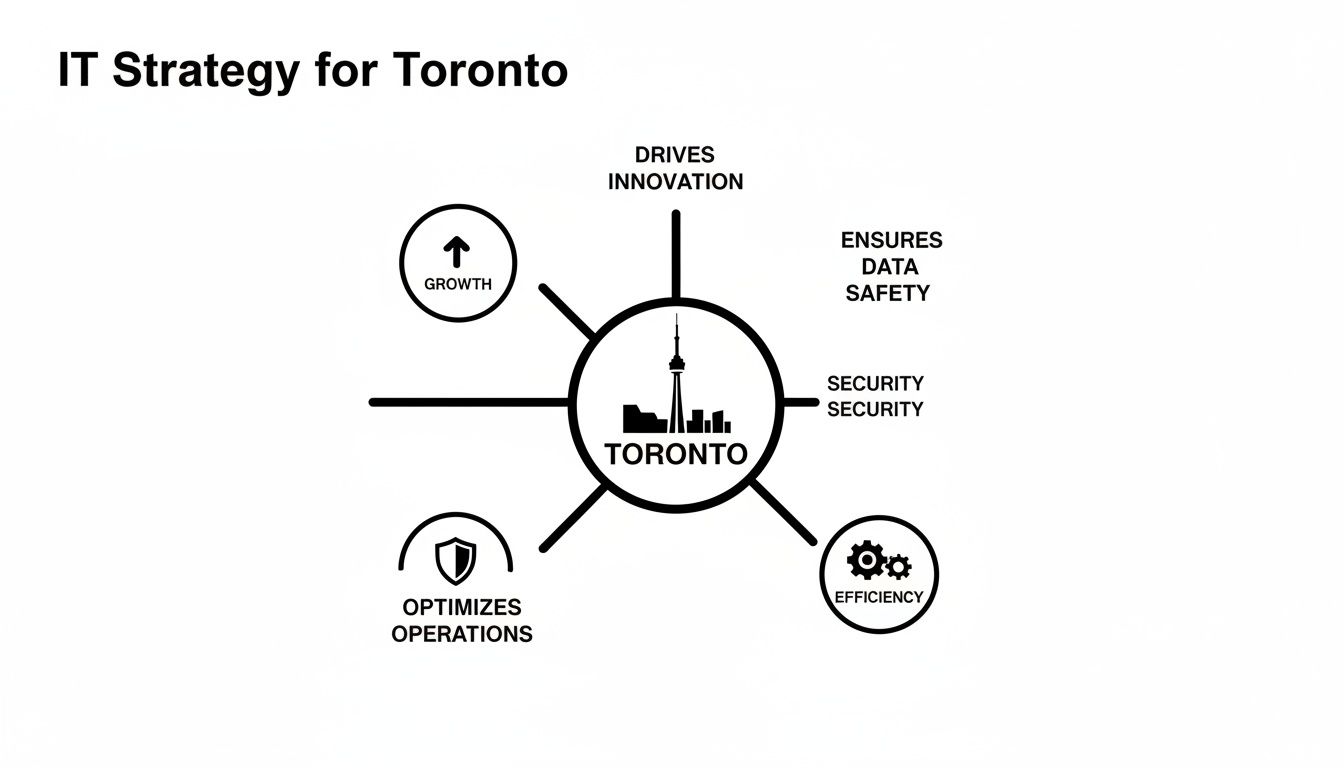
These elements are not isolated goals. They are interconnected components of a resilient operational framework that technology must support.
Managed IT Services: The Foundation of Stability
Managed IT services represent a fundamental shift in technology management. Instead of paying for repairs each time something breaks, you engage in an ongoing partnership for a flat monthly fee. This model covers everything from server maintenance and network monitoring to helpdesk support for your employees.
The primary benefit is predictability. Your IT budget becomes stable, and your systems remain operational, allowing your team to focus on their core responsibilities. Proactive maintenance addresses minor issues before they escalate into major disruptions, which is essential for maintaining productivity and client satisfaction.
Cybersecurity Services: Protecting Your Operations and Reputation
In the current threat landscape, robust cybersecurity is a fundamental business requirement. Cybersecurity consulting extends far beyond installing antivirus software. It involves architecting a multi-layered defense to protect your sensitive data, financial information, and client records from persistent threats.
These services typically include:
- Threat Monitoring: 24/7 surveillance of your network to detect and neutralize suspicious activity before a breach can occur.
- Compliance Management: Ensuring your IT practices adhere to industry regulations like PIPEDA or PHIPA, which is mandatory for legal, healthcare, and financial firms in Toronto.
- Employee Training: Educating your team to recognize and avoid phishing attempts and other social engineering tactics, which remain a primary vector for cyberattacks.
A data breach can cause severe financial and reputational harm. A strong cybersecurity posture is an investment in your company's continuity and your clients' trust. To learn more about the components of a comprehensive strategy, explore our complete guide to business IT services.
Fractional CIO: Strategic Leadership Without The Overhead
Many growing businesses require high-level technology leadership but cannot justify the expense of a full-time Chief Information Officer (CIO). A Fractional CIO (or vCIO) service provides executive-level strategic guidance on a part-time basis.
A vCIO helps you:
- Develop a long-term technology roadmap aligned with your business objectives.
- Manage IT budgets and vendor relationships to ensure optimal value.
- Assess new technologies and advise on investments that support growth and efficiency.
This service bridges the gap between daily operations and long-term vision, ensuring technology decisions are strategic and forward-looking. It provides access to seasoned executive expertise at a fraction of the cost.
Cloud and Microsoft 365 Consulting
Cloud platforms, particularly Microsoft 365, are central to modern business operations. However, simply owning the tools is insufficient. Effective consulting ensures you are using them securely and efficiently to maximize the return on your subscription.
A consultant helps configure tools like SharePoint for secure document management and Teams for streamlined collaboration, turning powerful software into a true strategic asset. This process involves customizing the platform to your specific workflow, security policies, and compliance needs.
Proper configuration prevents common but serious errors, such as data mismanagement or improper access controls. It transforms a standard office suite into a secure, collaborative, and highly productive ecosystem for your entire organization.
Meeting Industry-Specific Compliance In Toronto

For businesses in regulated industries in Toronto, a generic IT strategy is not just ineffective—it is a significant liability. Each sector operates under a distinct set of rules, and a security posture that is adequate for one industry can be dangerously insufficient for another. Failure to meet these obligations can result in substantial fines, operational disruption, and lasting reputational damage.
Effective IT consulting in Toronto addresses this by designing solutions tailored to your industry's specific legal and operational requirements. This is not a luxury; it is a fundamental component of risk management.
Legal Sector Data Security and PIPEDA
For Toronto law firms, client confidentiality is the foundation of professional practice. Firms are bound by strict ethical duties and privacy laws, including the Personal Information Protection and Electronic Documents Act (PIPEDA). There is no margin for error.
An IT partner with expertise in the legal sector will focus on critical security controls:
- Document Management Security: Implementing robust access controls and encryption for all sensitive files, client communications, and financial records, both on-premise and in the cloud.
- Secure Communication Channels: Establishing encrypted email and secure file-sharing portals to protect privileged information from interception.
- Data Residency and Sovereignty: Ensuring client data is stored in compliance with Canadian privacy laws and Law Society regulations.
Healthcare System Reliability and PHIPA
In healthcare, the stakes are even higher. Patient data is extremely sensitive, and system downtime can directly impact patient care. In Ontario, the Personal Health Information Protection Act (PHIPA) sets stringent standards for handling all personal health information.
An IT consultant with healthcare experience will prioritize:
- PHIPA Compliance: Conducting regular risk assessments and implementing the necessary technical safeguards to protect electronic health records (EHRs).
- System Uptime and Redundancy: Designing resilient systems with robust backup and disaster recovery plans to ensure critical platforms remain available.
- Secure Network Access: Managing network access for medical devices and personnel to prevent breaches without impeding clinical workflows.
Adherence to these standards is not merely about regulatory compliance; it is about maintaining patient trust. A single data breach can erode confidence built over many years. For organizations seeking to formalize their security posture, our SOC 2 compliance checklist provides a valuable starting point.
Financial Services and Data Integrity
Toronto’s financial firms operate under intense regulatory scrutiny. Client trust is the most valuable asset, and regulators require verifiable proof of data protection, transaction integrity, and operational resilience to protect investors and market stability.
Key IT focus areas for the financial sector include:
- Data Protection and Encryption: Implementing multi-layered security to safeguard client financial data, investment portfolios, and transaction records.
- High-Availability Infrastructure: Ensuring trading platforms, client portals, and core financial systems operate with near-zero downtime.
- Audit Trails and Reporting: Maintaining systems that log all access and modifications to sensitive data, creating a clear audit trail for regulatory reviews.
Manufacturing and Operational Technology Security
For manufacturers, IT extends beyond the office to the Operational Technology (OT) that runs plant floor machinery. Securing these systems is critical to preventing production stoppages and protecting intellectual property.
An IT consultant with manufacturing expertise will address:
- Securing the Factory Floor: Protecting industrial control systems (ICS) and SCADA networks from cyber threats that could halt operations.
- Supply Chain Optimization: Ensuring that systems managing inventory, logistics, and supplier communications are both efficient and secure.
- Protecting Intellectual Property: Safeguarding proprietary designs, formulas, and production processes from industrial espionage.
In each of these industries, specialized expertise is what connects technology to compliance and operational success, transforming IT from a potential liability into a strategic advantage.
How To Choose The Right IT Consulting Partner
Selecting an IT consulting partner in Toronto is a critical business decision that extends beyond technical qualifications. The right firm acts not as a vendor but as a strategic asset, aligning technology with your business goals to manage risk and support growth.
An incorrect choice can lead to operational disruptions, unexpected costs, and technology that hinders rather than helps your team.
Therefore, evaluating potential partners requires assessing their business acumen and operational maturity as much as their technical skills. Understanding their experience with your industry, company size, and specific operational challenges is fundamental to establishing a successful long-term partnership.
Evaluating Potential Partners
When engaging with IT consulting firms in Toronto, it is essential to move beyond the sales presentation. Your objective is to understand their problem-solving methodology, communication style, and commitment to your success. A true partner is invested in your outcomes, not just in securing a contract.
Key evaluation criteria include:
- Industry and Business Size Experience: Have they worked with businesses of your size and in your sector? A firm accustomed to large enterprises may not understand the budget and resource constraints of a mid-sized company. Similarly, a team without experience in regulated fields like law or healthcare will lack insight into your compliance requirements.
- Client Onboarding Process: Request a detailed walkthrough of their onboarding process. A clear, methodical plan for transitioning your systems indicates an organized and mature operation, minimizing disruption to your business.
- Service Level Agreements (SLAs): An SLA is a documented commitment. It must clearly define response times, issue resolution guarantees, and system uptime. Vague SLAs are a significant red flag and often lead to mismatched expectations.
- Strategic Planning and Roadmapping: How do they approach long-term planning? A strategic partner will work with you to develop a technology roadmap that supports your 1, 3, and 5-year business goals. This ensures your IT spending is proactive, not reactive.
It is also crucial to evaluate their commitment to client communication best practices during the evaluation. Clear, consistent, and transparent communication is the foundation of a strong partnership and prevents minor issues from becoming major problems.
Understanding Their Service Philosophy
Beyond technical capabilities, you must understand how a firm operates. What principles guide their service delivery? This provides insight into their company culture and whether they will be a collaborative and reliable partner. A key indicator is their approach to problem-solving and client education.
A valuable IT partner does more than resolve technical issues; they explain the business rationale behind their recommendations. This advisory approach empowers you to make more informed decisions about technology, translating complex topics into clear, actionable insights.
This partnership mindset is critical. A strategic partner helps you break the cycle of reactive fire-fighting and move toward proactive, stable operations. For a deeper perspective on this transition, our guide on the benefits of outsourcing IT services offers additional insights.
Comparing IT Support Pricing Models
An IT firm's pricing structure reflects its service philosophy. The two most common models are a fixed monthly fee (Managed Services) and hourly billing (Break-Fix). Understanding the difference is essential for controlling costs and ensuring your provider's incentives are aligned with your own.
A fixed-fee model incentivizes the provider to prevent problems, as they are responsible for remediation at their own cost. A break-fix model, conversely, can mean the provider profits more when your technology fails.
This table outlines the core differences to help you determine which model aligns with your budget and operational needs.
Comparing IT Support Pricing Models
| Pricing Model | How It Works | Best For | Potential Risks |
|---|---|---|---|
| Fixed-Fee (Managed Services) | A predictable, flat monthly fee covers all agreed-upon services, including proactive maintenance, monitoring, and unlimited support. | Businesses seeking predictable IT costs, high system reliability, and a strategic partner focused on preventing downtime. | The SLA must be specific about what is included to avoid scope creep or unexpected charges. |
| Break-Fix (Time & Materials) | Billed at an hourly rate for labor, plus the cost of parts, only when a problem occurs and you request service. | Companies with very simple IT needs and a high tolerance for downtime, or those requiring occasional, one-off support. | Costs are unpredictable and can escalate significantly during a major incident. The provider has no financial incentive to prevent future problems. |
Ultimately, the choice of a pricing model depends on your risk tolerance and whether you prefer a proactive or reactive relationship. For most growing Toronto businesses, the stability and strategic alignment of a fixed-fee model provide superior long-term value, ensuring your IT partner is fully invested in keeping your operations running smoothly.
Common IT Mistakes That Weaken Toronto Businesses

Even well-managed businesses in Toronto can fall into common technology traps. These are typically not dramatic, single-point failures but subtle oversights that gradually drain resources, increase risk, and limit growth potential.
These missteps compound over time, creating operational friction and a competitive disadvantage. Identifying these common pitfalls is the first step toward building a more resilient and efficient organization. By understanding where others go wrong, you can steer your business toward a more secure and strategic future.
Neglecting Proactive Cybersecurity Measures
A dangerous mistake is treating cybersecurity as a one-time task rather than an ongoing process. Many businesses only prioritize security after a breach, by which point significant damage has already occurred. This reactive posture is always more costly than prevention and exposes the business to data theft, ransomware, and severe reputational harm.
Proactive cybersecurity is a layered defence that includes:
- Continuous Monitoring: Actively observing your network for anomalous activity to neutralize threats before they escalate.
- Regular Security Assessments: Systematically identifying and remediating vulnerabilities before attackers can exploit them.
- Employee Security Training: Your staff is the first line of defence. Training them to recognize phishing attacks is critical, as human error remains a primary entry point for cybercriminals.
Ignoring these fundamentals is equivalent to leaving your office unlocked. A proactive security posture minimizes risk and protects the trust you have built with your clients.
Operating Without a Strategic IT Roadmap
Another common pitfall is managing technology without a clear, long-term plan. When decisions are made in isolation—buying a new server to address a slowdown or adopting new software without considering integration—the result is a disjointed and inefficient technology environment. This reactive spending turns IT into a source of frustration rather than a tool for growth.
An IT roadmap serves as a strategic plan, aligning technology investments with your business goals over a one- to three-year horizon. It provides a clear framework for budgets, upgrades, and projects, ensuring every dollar spent on technology moves your company forward.
Mismanaging Data and Compliance
In today's regulatory environment, improper data management creates significant compliance risk. Using powerful platforms like Microsoft 365 does not automatically ensure compliance. Misconfigured settings can easily lead to unauthorized access to sensitive client, financial, or employee data, creating serious legal and financial liabilities.
The rapid growth of Toronto's tech sector underscores this challenge. Canada's IT services market is projected to reach USD 60.08 billion in 2025 and is expected to more than double by 2030, led by cybersecurity and cloud services. As detailed in the full IT services market report, this growth is driven by the urgent need for businesses to address security and compliance correctly.
It is a critical error to assume default settings are secure. Proper data governance requires the deliberate configuration of access controls, retention policies, and security protocols to protect information and meet standards like PIPEDA.
Resisting Necessary Infrastructure Modernization
Retaining aging hardware and outdated software is a false economy. While it may seem to save money by deferring upgrades, legacy technology carries significant hidden costs, including decreased productivity, unpatched security vulnerabilities, and a higher risk of unexpected downtime that can halt operations.
Modernizing infrastructure does not always require a complete overhaul. A strategic IT partner can help identify targeted upgrades that deliver the greatest return on investment, improving performance, enhancing security, and preparing your business for future growth. Avoiding these common mistakes is essential for any leader seeking to build a resilient and competitive organization in Toronto.
What to Do Next
This guide demonstrates that strategic IT consulting is not an expense but an investment in your company's resilience, efficiency, and future growth. The critical step is to shift from a reactive, break-fix mindset to a proactive technology plan that directly supports your long-term business objectives. This transition is how you build a true competitive advantage.
The path forward begins with an objective assessment of your current state. Take the time to identify your team's most persistent IT challenges and clarify your primary business goals for the next 12-24 months.
Gaining Clarity and Taking Action
This internal assessment will make subsequent conversations with potential IT partners far more productive. With clear objectives, you can evaluate firms based on their ability to solve your specific business problems, not on a generic list of technical capabilities.
The ultimate goal is to find a partner who aligns technology directly with your business success. A professional IT assessment provides an objective, third-party view of your current state and delivers a clear, actionable roadmap for the future.
A proper assessment should identify risks, highlight opportunities for improvement, and outline a practical budget. This process empowers you to make informed decisions and ensures your technology investments deliver measurable returns. It transforms IT from a source of operational friction into a powerful engine for growth.
To understand how a comprehensive assessment can benefit your Toronto business, we recommend scheduling a consultation. This no-obligation discussion is an effective way to define your needs and explore how a strategic partnership can secure your operations for the future.
Frequently Asked Questions About IT Consulting In Toronto
Business leaders evaluating IT consulting in Toronto often have similar questions. Here are straightforward answers to common queries about services, costs, and the partnership process.
What is the difference between Managed IT Services and Break-Fix Support?
The primary difference is the approach: proactive versus reactive.
Break-fix support is an on-demand, reactive service. When a technology failure occurs—a server outage, an email malfunction—you request assistance and are billed for the time and materials required for the repair. This model often leads to unpredictable costs and significant business disruption due to downtime.
Managed IT services operate on a proactive model. You pay a consistent monthly fee for a dedicated team to continuously monitor, maintain, and support your entire IT environment. The objective is to prevent problems before they occur, ensuring operational stability and making your IT budget predictable.
How much should our business budget for IT consulting?
There is no single answer, as the budget depends on your company's size, technological complexity, and any specific industry compliance requirements. However, most firms offering a fixed-fee managed services model provide a clear, all-inclusive monthly price, often calculated on a per-user or per-device basis.
A reputable IT partner will not provide a quote without first conducting a thorough assessment of your current environment. This discovery process ensures the proposed solution accurately matches your needs and prevents hidden fees or scope gaps later.
This initial deep dive is crucial—it guarantees the services you pay for are directly aligned with your business goals and operational realities.
What does the onboarding process typically involve?
A structured onboarding process is a sign of a professional and experienced IT consulting firm. It is designed to ensure a seamless transition with minimal disruption to your daily operations.
The process typically includes several key phases:
- Discovery and Assessment: The consulting team performs a comprehensive review of your current IT systems, security posture, and business workflows.
- Strategic Planning: Based on the assessment, they develop a customized IT roadmap and service plan that addresses immediate needs and aligns with long-term goals.
- System Deployment: The technical phase involves deploying monitoring agents, security tools, and backup solutions across your network to establish management and protection.
- Team Introduction and Training: Your staff is introduced to the new support system, learning how to submit requests and receiving any necessary training on new tools or processes.
This methodical approach ensures that from day one, your technology is managed effectively, and your team knows exactly how to get the support they need.
Navigating these decisions is simpler with an experienced partner. Tricord I.T Solutions provides the strategic guidance and proactive support Toronto businesses need to thrive. Schedule a consultation to build your IT roadmap today.